
Residence Permit in Dubai
Table of Contents Residence Permit in Dubai: A Practical Guide for Foreign Investors and Expats (2026) Understanding Residence Permits in Dubai How the UAE Residence System Works Main Types of Residence Permits in Dubai
Golden Visa and Long Term Residency Investor Residence Visa Employment Residence Visa Family Sponsorship Residence Visa Residence Permit via Real Estate Key Differences Between Short Term and Long Term Residency Options Cost,Timelines, and Validity Periods Common Misunderstandings About Residence Permits in Dubai Who Should Consider Dubai for Residency Purpose? Dubai vs Other Emirates: Why Dubai Is often Used as the Reference Point Strategic Perspective: Residency as A Part of A Broader UAE Strategy Next Step: Choosing the Right Residency Path Frequently Asked Questions
Residence Permits in Dubai: A Practical Guide for Foreign Investors and Expats (2026)
Dubai offers one of the most structured and accessible residency systems in the region, yet the concept of a “residence permit” is often misunderstood. There is no single visa that fits every profile. Instead, Dubai operates a multi-layered residence framework that includes long-term options such as the Golden Visa, as well as investor, employment, and family-based permits.
This guide is designed to clarify how residence permits in Dubai actually work, how different options compare, and why choosing the wrong permit is one of the most common, and costly, mistakes foreign applicants make. Rather than focusing on applications or promotions, the objective here is simple: to help you understand which residency path aligns with your personal goals, investment logic, and long-term plans.
Dubai is used as the primary reference market due to its mature legal framework and transparent property and residency processes. Where relevant, broader UAE considerations are addressed to provide context, without oversimplifying the differences between emirates.
Note: This guide is designed for orientation. Residency rules and eligibility can change, and the right path depends on your objective and timeline.
Which residence permit fits your situation in Dubai?
Answer three quick questions to clarify your residency path. No application. Just orientation.
By continuing, your answers will be shared via WhatsApp so we can provide orientation.
No commitment. No application. Just orientation.
Privacy Policy
Scroll to the bottom to enable “I’ve read it”. Open in new tab
Understanding Residence Permits in Dubai
A residence permit in Dubai grants a foreign national the legal right to live in the emirate for a defined period under specific conditions. It is not a one-time authorization, but a renewable legal status that allows an individual to reside, open bank accounts, sign long-term contracts, and access essential services within the UAE.
It is important to distinguish a residence permit from an entry visa. An entry visa only allows a person to enter the country for a limited period and for a specific purpose, such as tourism, business meetings, or initiating a residency process. A residence permit, on the other hand, defines the individual’s ongoing legal status in Dubai and determines the scope of their rights and obligations while living in the emirate.
From a legal perspective, a residence permit establishes a formal link between the individual and the UAE’s regulatory system. It determines sponsorship structure, duration of stay, renewal requirements, and compliance obligations. This status does not grant citizenship, but it provides long-term stability and legal clarity for foreign residents operating or investing in the region.
Dubai is widely used as the reference emirate for residence permits because of its mature administrative infrastructure, transparent procedures, and investor-friendly framework. Compared to other emirates, Dubai offers clearer documentation standards, faster processing timelines, and a well-defined legal environment, making it the most commonly cited benchmark when discussing residency options within the UAE.
How the UAE Residence System Works
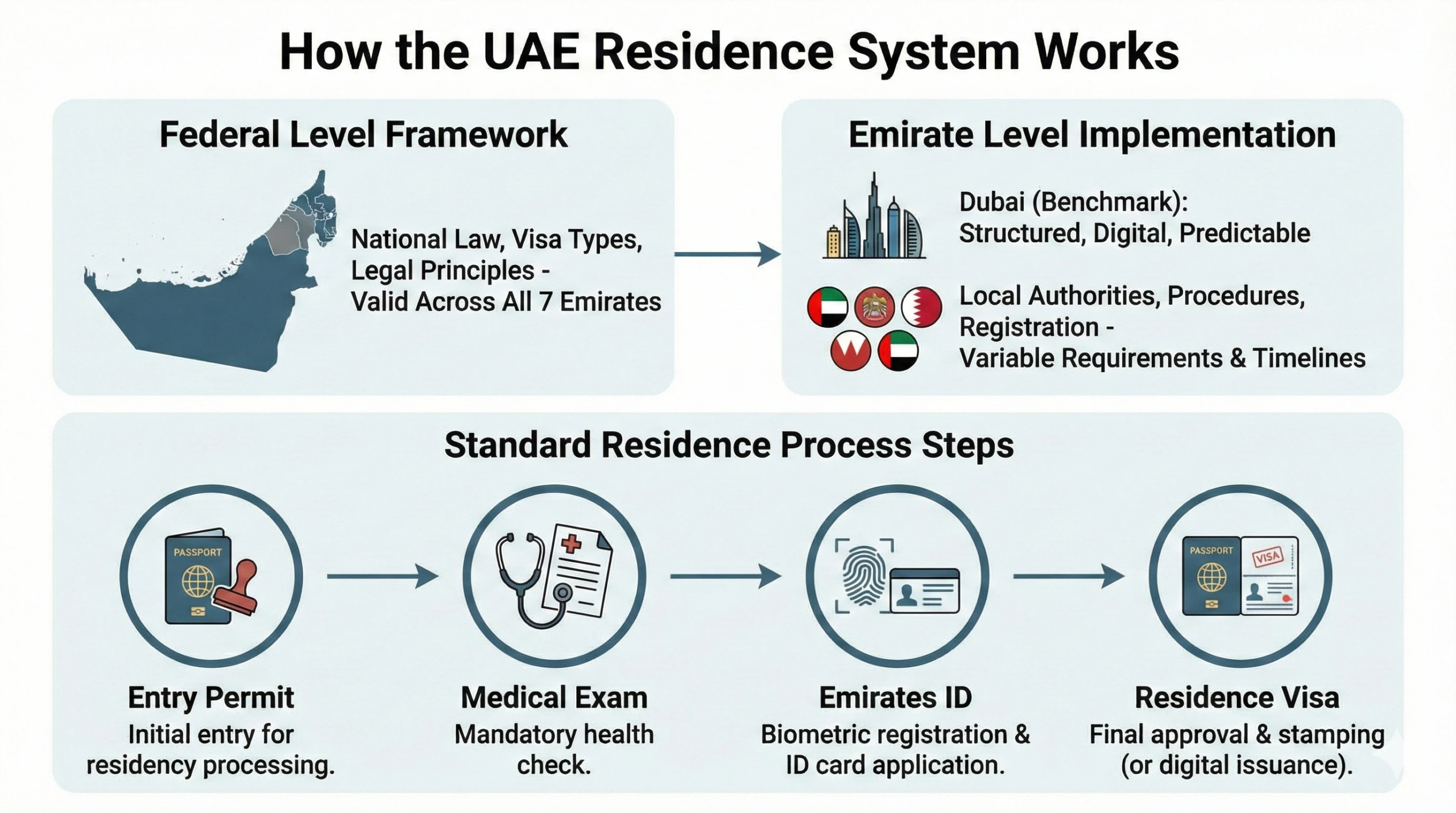
The UAE residence system is structured at the federal level, meaning that residency categories, visa types, and overarching legal principles are defined nationally across the United Arab Emirates. This federal framework ensures that residence permits are recognized and valid throughout all seven emirates, regardless of where they are issued.
However, while the legal foundation is federal, the implementation of residence permits is managed at the emirate level. Each emirate administers residency processes through its own local authorities, registration systems, and procedural standards. As a result, documentation requirements, processing timelines, valuation practices, and administrative efficiency can vary from one emirate to another.
Dubai is commonly used as the reference market because it offers the most structured and consistent residency ecosystem within the UAE. Its digitalized government services, clearly defined property registration systems, and established investor pathways provide greater predictability for foreign residents. For this reason, Dubai often sets the practical benchmark against which residency procedures in other emirates are compared.
Detailed emirate-specific residence frameworks across the UAE are addressed separately in our dedicated UAE Residence Guide.
Important: A residence permit is not the same as citizenship. Residency rules focus on legal stay status and compliance requirements, not nationality outcomes.
Main Types of Residence Permits in Dubai
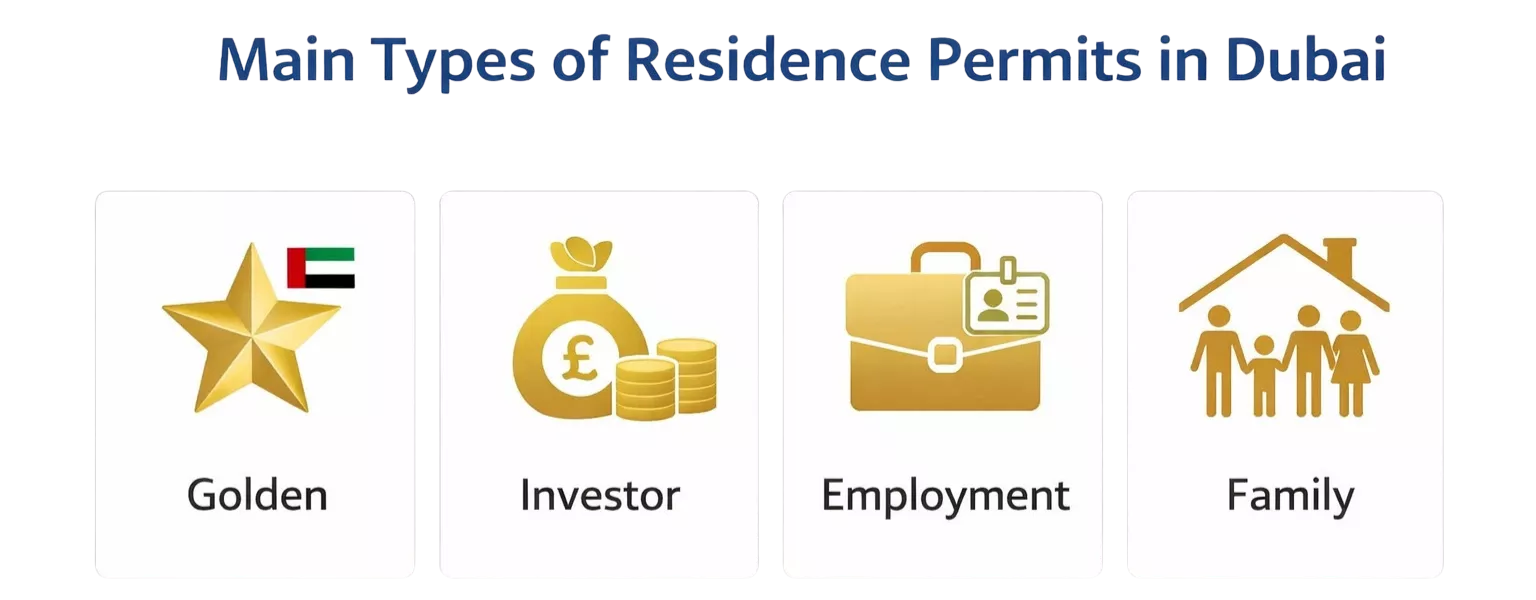
Dubai offers several residence permit options designed for different profiles, timelines, and objectives. Each permit type carries distinct rights, durations, and eligibility requirements. Understanding these differences is essential before selecting a residency pathway, as choosing the wrong category can create unnecessary limitations or renewal risks.
Beyond investor and employment-based residency, Dubai also offers separate remote work and freelance residence options for location-independent professionals. These programs are designed for individuals whose professional activities and income remain outside the UAE and are generally not linked to property ownership or long-term investment structures.
Golden Visa and Long Term Residency
The Golden Visa is a long-term residence permit valid for up to 10 years, designed for investors, entrepreneurs, professionals, and individuals who meet specific eligibility criteria defined at the federal level. Unlike standard residence permits, the Golden Visa provides extended stability and does not require continuous local sponsorship in the traditional sense.
This residency option is primarily suited for individuals seeking long-term presence in the UAE, particularly those aligning residency with investment, business structuring, or capital preservation strategies. It is commonly used by property investors, high-net-worth individuals, and professionals who require long-term legal continuity rather than short renewal cycles.
It is important to note that long-term residency in Dubai is not limited exclusively to the Golden Visa. Many residents obtain renewable two-year residence permits through qualifying real estate ownership, company establishment, or employment-based sponsorship. While these permits require periodic renewal, they still allow individuals and families to maintain a stable, long-term presence in the UAE without meeting Golden Visa thresholds.
While the Golden Visa is often associated with real estate investment, it is not a universal solution for every applicant. Eligibility depends on the structure, value, and ownership conditions of the investment, as well as the applicant’s broader profile and timeline.
From an investment perspective, real estate remains the most transparent and widely used pathway for residency planning in Dubai. Employment-based and company-sponsored residence permits follow separate legal processes and are typically handled directly by employers or licensed visa consultants. This guide focuses on residency options connected to property ownership and long-term investment strategy, rather than visa application services.
→ Explore the Golden Visa via Real Estate in Dubai
Investor Residence Visa
The Investor Residence Visa is a renewable residence permit designed for individuals who establish a business or hold qualifying investments in Dubai. This visa can be structured through company ownership or qualifying real estate, depending on the applicant’s activity and setup.
Unlike the Golden Visa, the Investor Residence Visa is typically issued for a shorter validity period and is more closely tied to the ongoing status of the underlying business or investment. Renewal depends on maintaining the qualifying structure, such as active company registration or continued ownership of the qualifying asset.
This option is generally suitable for investors who require residency to operate a business, manage local activities, or maintain a physical presence in Dubai without committing to a long-term residency framework.
For investors, residency is typically structured alongside the underlying asset or business, rather than as a standalone advisory service.
Employment Residence Visa
The Employment Residence Visa is issued under a sponsored structure, where the employer acts as the legal sponsor for the employee. This residence permit is directly linked to an active employment contract registered in Dubai.
The validity of this visa is dependent on the continuation of the employment relationship. If the employment ends, the residence permit becomes subject to cancellation or transition within defined grace periods. This option is primarily suited for professionals relocating to Dubai for salaried roles within registered companies.
Family Sponsorship Residence Visa
The Family Sponsorship Residence Visa allows residents of Dubai to sponsor eligible family members, including spouses and dependent children, under their primary residence permit. This visa type does not function independently and is fully dependent on the validity of the main sponsor’s residence status.
Family residency remains active only as long as the primary sponsor’s residence permit is valid and compliant. Any change to the main residency status directly impacts sponsored family members, making long-term planning and permit alignment essential for families relocating to Dubai.
Residence Permit via Real Estate
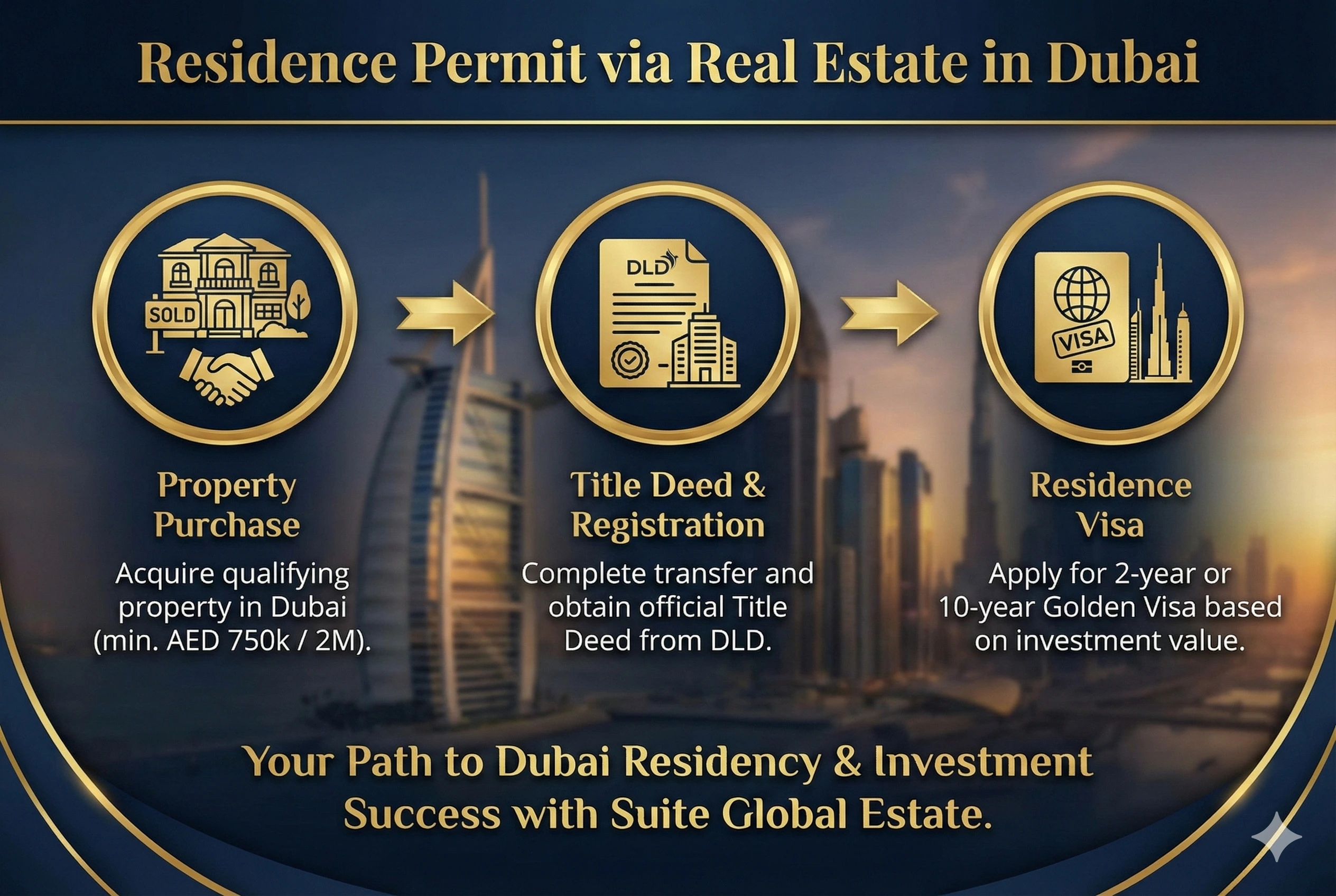
Real estate plays a significant role within Dubai’s residency framework, as property ownership can serve as a qualifying basis for certain residence permits. For many foreign nationals, property-based residency represents a practical way to align long-term presence in Dubai with asset ownership, particularly in a market known for transparent registration and investor-oriented regulation.
It is important to distinguish between property-based Investor Residence Visas and the Golden Visa obtained through real estate investment. A standard investor residence visa linked to property ownership typically offers shorter validity periods and requires regular renewal tied to the continued status of the qualifying asset. The Golden Visa, by contrast, provides long-term residency of up to 10 years, subject to specific investment thresholds and ownership conditions.
This pathway is one of the most frequently discussed residency options because it combines residency planning with capital allocation. However, it is also one of the most misunderstood. Property ownership alone does not automatically guarantee long-term residency, and the suitability of this route depends heavily on the investor’s profile, timeline, and strategic objectives.
→ Explore the Golden Visa via Real Estate in Dubai
Tip: If you are undecided, define your expected timeline first (short term vs long term). It immediately narrows the most suitable residency paths.
Strategic note Golden Visa consideration
Real estate based residency options are often perceived as a universal solution. In practice, they deliver the strongest results only when aligned with the right investor profile, objectives, and timeline. Without this alignment, long term residency can create unnecessary constraints rather than flexibility.
Explore Golden Visa via Real Estate →
Privacy confirmation
Please review our Privacy Policy. To continue to WhatsApp, you must explicitly confirm your agreement.
By clicking “I agree”, you confirm that you have read and accepted our Privacy Policy.
Key Differences Between Short Term and Long Term Residency Options
Residency options in Dubai generally fall into two broad categories: short-term residence permits, typically valid for two to three years, and long-term residency options, such as the 10 year Golden Visa. While both provide legal residence, they serve different purposes and planning horizons.
Short-term residence permits are commonly tied to employment, business activity, or qualifying investments that require regular renewal. These permits offer flexibility but demand ongoing administrative attention, as eligibility must be maintained and reevaluated at each renewal cycle.
Long-term residency options prioritize stability and continuity. With extended validity periods, they reduce renewal frequency and provide greater predictability for individuals aligning residency with long-term investment or lifestyle planning. However, they often come with higher eligibility thresholds and stricter qualification criteria.
Understanding the differences in renewal requirements, permitted activities, and long-term limitations is essential. Selecting the appropriate residency duration should be based not on perceived prestige, but on how well the permit supports the individual’s objectives and risk tolerance over time.
Did You Know? Many applicants start from the visa type first. A more reliable approach is to start from your objective, then match the right residency structure.
Costs, Timelines, and Validity Periods
The cost of obtaining a residence permit in Dubai varies depending on the type of residency, sponsorship structure, and duration of validity. Rather than fixed amounts, most residency pathways operate within defined cost ranges, influenced by factors such as government fees, medical examinations, documentation, and administrative processing. Long-term residency options generally involve higher upfront thresholds, while short-term permits distribute costs across more frequent renewal cycles.
Processing timelines also differ by residency type. Standard residence permits are typically issued within predictable timeframes once documentation is complete, while long-term residency options may require additional verification steps. In most cases, the overall process is structured and transparent, particularly when applications are aligned with clearly defined eligibility criteria.
Renewal requirements represent one of the most important practical considerations. Short-term residence permits require periodic renewal and continued compliance with eligibility conditions. Long-term residency options reduce renewal frequency but still depend on maintaining the qualifying status throughout the validity period. Understanding these renewal realities is essential for ensuring uninterrupted residency and long-term legal continuity in Dubai.
Warning: Choosing a residency path without clarity can create avoidable friction later—renewals, restructuring, and limitations that were not obvious at the start.
Common Misunderstandings About Residence Permits in Dubai
One of the most common misconceptions is that the Golden Visa is available to every investor. In reality, Golden Visa eligibility is based on specific criteria related to investment structure, value, and long-term qualification standards. Not every investment, including property ownership, automatically leads to long-term residency.
Another frequent misunderstanding is the assumption that a residence permit equals citizenship. A residence permit grants the legal right to live in Dubai for a defined period but does not provide citizenship, permanent residency, or political rights. Residency status remains conditional and subject to renewal or continued eligibility.
There is also widespread confusion between Dubai and other emirates. While residence permits are part of a federal UAE framework, application processes, administrative standards, and practical implementation vary by emirate. Using Dubai as a reference point does not mean that identical rules apply across all emirates, and assuming uniformity can lead to incorrect planning decisions.
Before you choose a residency path Many applicants choose the wrong residence permit simply because they start from the visa type, not from their actual objective. Clarifying your purpose, timeline, and level of commitment early on can prevent unnecessary limitations and repeated adjustments later. Avoid common residency mistakes →
Privacy confirmation
Please review our Privacy Policy. To continue to WhatsApp, you must explicitly confirm your agreement.
By clicking “I agree”, you confirm that you have read and accepted our Privacy Policy.
Who Should Consider Dubai for Residency Purposes?
Dubai is particularly well suited for individuals seeking a structured residency environment supported by clear regulations and internationally oriented infrastructure. For investors, Dubai offers a stable legal framework where residency can be aligned with asset ownership, capital allocation, and long-term planning.
For entrepreneurs and business owners, residency in Dubai enables operational presence, company formation, and access to regional and global markets. The residency system supports business activity without imposing unnecessary personal residency constraints, making it attractive for internationally active founders.
Dubai is also an effective base for individuals pursuing a mobile or internationally distributed lifestyle. Its connectivity, predictable residency rules, and flexible travel access allow residents to maintain global mobility while retaining a clear legal residence in the UAE.
Dubai vs Other Emirates: Why Dubai Is Often Used as the Reference Point
Dubai is frequently used as the benchmark for residency discussions within the UAE due to its market liquidity, procedural clarity, and foreigner-friendly infrastructure. These factors create a more predictable environment for residency planning, particularly for investors and internationally mobile individuals.
From a liquidity perspective, Dubai offers the deepest and most transparent real estate market in the UAE. This depth supports clearer valuation standards and smoother alignment between property ownership and residency eligibility, which is less consistent in emerging emirates.
Administrative processes in Dubai are generally more standardized and digitally integrated, reducing ambiguity in documentation, timelines, and compliance requirements. This procedural clarity makes Dubai the most commonly referenced emirate when evaluating residence permit pathways.
While other emirates such as Abu Dhabi,Ras Al Khaimah and Umm Al Quwain offer alternative investment environments, their residency and property ecosystems follow different development stages. These distinctions are best assessed separately and are addressed in dedicated emirate-specific guides.
Strategic Perspective: Residency as Part of a Broader UAE Strategy
Residency should not be viewed as a measure of investment success. Holding a residence permit in the UAE does not automatically translate into financial performance, capital growth, or portfolio resilience. Treating residency as a standalone objective often leads to misaligned decisions.
Effective residency planning requires a broader strategic perspective that considers lifestyle goals, investment structure, mobility needs, and long-term risk management. The choice of residency type should support these objectives rather than dictate them.
A long-term approach allows residency to function as a stabilizing element within a wider UAE strategy—one that balances flexibility, legal continuity, and capital allocation. When residency is positioned correctly, it becomes a supportive framework rather than a constraint.
Next Steps: Choosing the Right Residency Path
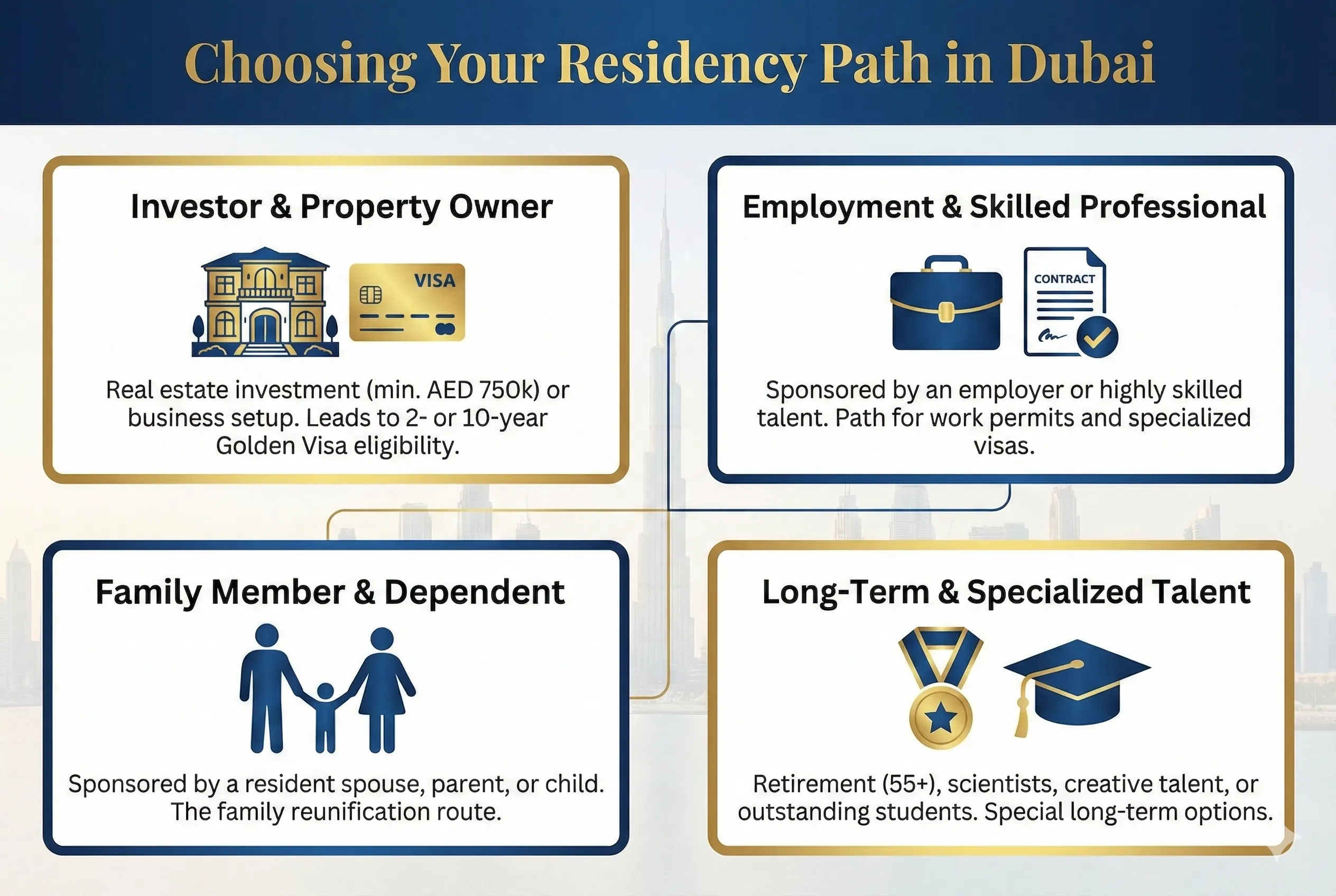
Choosing the right residency path in Dubai is best approached as a decision framework, not a single application step. Factors such as purpose of stay, time horizon, investment involvement, and lifestyle priorities should be evaluated together before selecting a specific residence permit.
This guide is not intended to direct you toward a particular visa type, but to help you understand how different options function and where they may, or may not, fit your situation. Clarity at this stage reduces the need for future adjustments and minimizes unnecessary constraints.
If you are uncertain which residency path aligns with your objectives, a brief orientation can help clarify your options before any formal commitment.
Frequently Asked: No single residence permit fits every profile. The best option depends on your purpose, time horizon, and whether real estate is part of your plan.
Frequently Asked Questions About Dubai Residence Permits
Do I need to buy property to obtain a residence permit in Dubai?
No. Real estate ownership is only one of several pathways. Dubai offers residency options linked to employment, business setup, long term visas, and investment structures. The correct option depends on your objective, timeline, and level of commitment.
What is the difference between a residence visa and the Golden Visa in Dubai?
A standard residence visa is typically valid for 2–3 years and linked to employment, company ownership, or sponsorship. The Golden Visa is a long term residency option designed for specific investor, professional, and high net worth profiles, usually offering 5 or 10 year validity.
Is real estate based residency suitable for everyone?
Not necessarily. Property based residency works best when it aligns with long term plans and investment logic. For some individuals, it adds flexibility. For others, it can create unnecessary constraints if chosen without a clear strategy.
Can foreigners obtain residency in Dubai without living there full time?
Yes, depending on the visa type. Some residence permits allow flexible stay requirements, while others require minimum presence. Understanding these conditions in advance is essential to avoid compliance issues later.
Does a Dubai residence permit lead to citizenship?
No. Dubai residency does not lead to citizenship. Residence permits provide legal stay rights, access to local services, and mobility benefits, but they do not convert into nationality.
What are the most common mistakes applicants make when choosing a residency path?
The most common mistake is starting from a visa type instead of starting from personal objectives. Many applicants focus on the permit label rather than evaluating lifestyle goals, investment horizon, and exit flexibility.
Is the Golden Visa automatically granted after purchasing property?
No. Property ownership alone does not guarantee approval. Eligibility depends on property value thresholds, ownership structure, and compliance with current regulations at the time of application.
Can I change my residency type later if my situation changes?
In many cases, yes. However, switching residency paths can involve additional costs, administrative steps, and timing considerations. Choosing the right structure from the beginning reduces the need for future adjustments.
How long does the residency application process usually take?
Processing times vary based on the residency type and individual circumstances. Some permits can be issued within weeks, while others require more extensive documentation and verification.
How do I know which residency option fits my situation best?
There is no universal answer. The right residency path depends on your goals, expected duration, investment involvement, and flexibility needs. A short orientation focused on your profile often provides clarity before any formal commitment.
No. Real estate ownership is only one of several pathways. Dubai offers residency options linked to employment, business setup, long term visas, and investment structures. The correct option depends on your objective, timeline, and level of commitment.
A standard residence visa is typically valid for 2–3 years and linked to employment, company ownership, or sponsorship. The Golden Visa is a long term residency option designed for specific investor, professional, and high net worth profiles, usually offering 5 or 10 year validity.
Not necessarily. Property based residency works best when it aligns with long term plans and investment logic. For some individuals, it adds flexibility. For others, it can create unnecessary constraints if chosen without a clear strategy.
Yes, depending on the visa type. Some residence permits allow flexible stay requirements, while others require minimum presence. Understanding these conditions in advance is essential to avoid compliance issues later.
No. Dubai residency does not lead to citizenship. Residence permits provide legal stay rights, access to local services, and mobility benefits, but they do not convert into nationality.
The most common mistake is starting from a visa type instead of starting from personal objectives. Many applicants focus on the permit label rather than evaluating lifestyle goals, investment horizon, and exit flexibility.
No. Property ownership alone does not guarantee approval. Eligibility depends on property value thresholds, ownership structure, and compliance with current regulations at the time of application.
In many cases, yes. However, switching residency paths can involve additional costs, administrative steps, and timing considerations. Choosing the right structure from the beginning reduces the need for future adjustments.
Processing times vary based on the residency type and individual circumstances. Some permits can be issued within weeks, while others require more extensive documentation and verification.
There is no universal answer. The right residency path depends on your goals, expected duration, investment involvement, and flexibility needs. A short orientation focused on your profile often provides clarity before any formal commitment.
Define Your Residency Strategy
We do not process visas blindly. We help clients define the right residency path based on lifestyle goals, investment logic, and long term plans.
Initial orientation – no obligation
Privacy confirmation
Please review our Privacy Policy. To continue to WhatsApp, you must explicitly confirm your agreement.
By clicking “I agree”, you confirm that you have read and accepted our Privacy Policy.