Why Dubai Remains a Global Capital Magnet (2026 Guide)
On this page
- Beyond Real Estate: Understanding Dubai’s Role in the Global Financial Order
- Why Does Global Capital Continue to Flow into Dubai in 2026?
- Global Capital Flows: Why Money Keeps Moving to Dubai
- A Tax Efficient Environment for International Capital
- Strategic Geography: Connecting Europe, Asia, and the Middle East
- Logistics and Financial Connectivity
- Lifestyle and Business Integration
- Capital Stability vs. Speculation: What Dubai Actually Offers
- The Shift Toward End Users
- Regulatory Maturity
- Liquidity and Exit Visibility
- The 2026 Infrastructure Pivot: Why Now?
- Who Is Dubai’s Capital Environment Best Suited For?
- Case Study in Action: The "Hybrid" Preservation Strategy
- Frequently Asked Questions
- Common Misconceptions About Dubai as a Capital Hub
- Conclusion: The Next Step
Beyond Real Estate: Understanding Dubai’s Role in the Global Financial Order
In an era defined by shifting geopolitical alliances, regulatory tightening, and persistent economic volatility, global capital no longer seeks growth alone. It seeks security, jurisdictional clarity, and long-term resilience.
By 2026, Dubai has decisively moved beyond its former perception as a luxury real estate hotspot, emerging instead as a Dubai global capital hub engineered for long-term capital positioning. It has evolved into a mature, strategically engineered jurisdiction where capital preservation in Dubai is supported by regulatory clarity, sovereign stability, and long-term policy alignment.
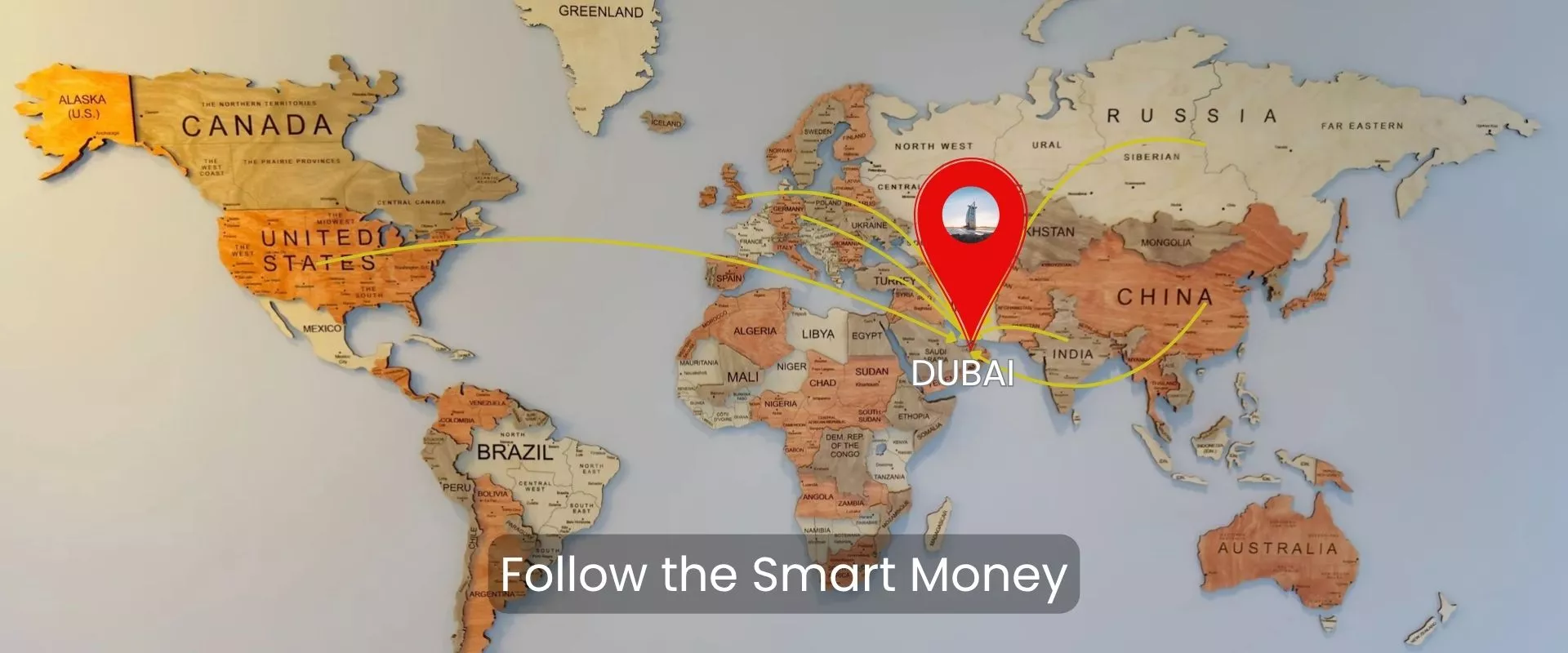
Rather than competing directly with traditional Western financial centers, Dubai has carved out a distinct role within the global financial order: a neutral, business-oriented node that connects East and West, emerging and developed markets, growth and preservation strategies.
What this guide covers
- → What makes Dubai a capital hub in 2026 (3 structural drivers)
- → Tax and compliance reality: UAE-side vs home jurisdiction
- → Which investor profiles benefit most and how to position
This guide examines the structural, fiscal, and geopolitical drivers behind Dubai’s continued capital inflows, not as a speculative trade, but as a deliberate capital positioning decision made by sophisticated global investors.
Why Does Global Capital Continue to Flow into Dubai in 2026?
The answer is rarely tied to a single asset class or short-term opportunity. For investors seeking clarity beyond headlines, the answer to why global capital flows to Dubai lies in jurisdictional stability, strategic access, and long-term capital preservation rather than short-term opportunity.
For many investors, Dubai represents a platform rather than a product.
Strategy Takeaway Dubai is best understood as a jurisdictional platform, not a single-asset opportunity. Before you evaluate yields or price cycles, define your objective and time horizon. The strongest outcomes typically come from aligning capital preservation, liquidity planning, and jurisdictional clarity, then selecting assets that fit that thesis.
Before analyzing macroeconomic indicators or asset-level returns, it is essential to clarify your underlying motivation for entering this market:
- Are you seeking yield, or long-term capital appreciation?
- Are you diversifying geographic and jurisdictional exposure?
- Are you prioritizing capital preservation in Dubai within a volatile global environment?
Understanding this context is the first step toward building a tax efficient investment strategy in Dubai that aligns with your time horizon, risk tolerance, and global portfolio structure.
Understand Dubai’s Capital Logic A brief orientation to align your objective (preservation, yield, or strategic base) with the right market approach. No obligation.
Start Your Assessment View Capital Profiles →
Global Capital Flows: Why Money Keeps Moving to Dubai
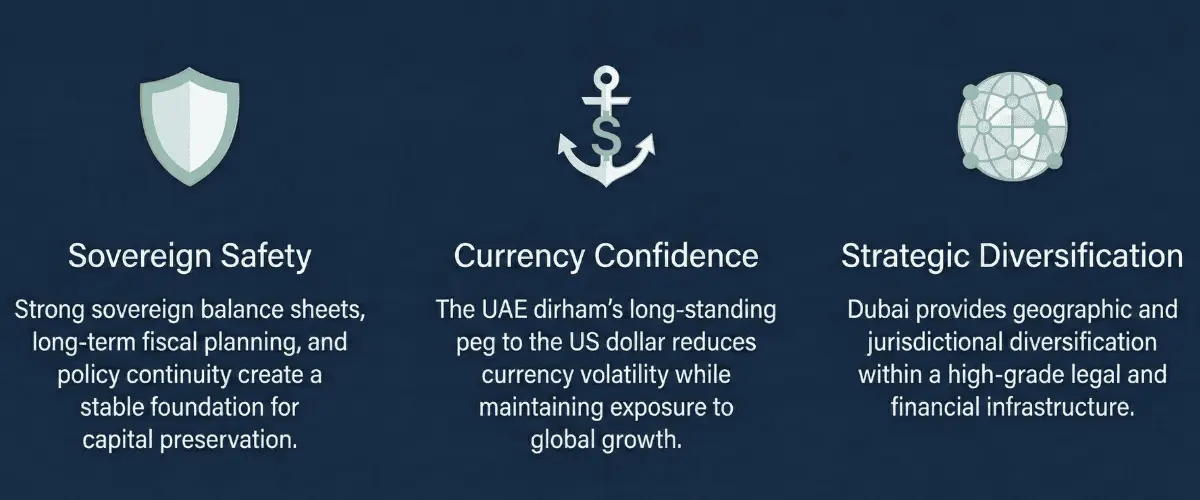
Capital flow logic (2026) Global capital increasingly prioritizes neutrality and predictability. Dubai’s advantage lies in the combination of sovereign stability, currency structure, and operational connectivity rather than any single headline-driven catalyst.
Within this broader trend of global capital allocation, Dubai real estate investment 2026 is increasingly viewed not as a short-term trade but as a strategic allocation anchored in diversified capital flows and structural market drivers. The global economic landscape of 2026 is increasingly shaped by one dominant theme: the search for neutrality and resilience. As inflationary pressures persist and regulatory frameworks tighten across traditional Western financial centers, institutional and private investors alike are reassessing where capital can operate with both efficiency and predictability.
In this environment, Dubai has emerged as a geopolitically neutral jurisdiction, offering a rare convergence point where Eastern and Western capital can coexist, transact, and scale without the friction of polarized political agendas. Often positioned as a neutral, business-oriented jurisdiction, Dubai offers structural rather than ideological alignment, a critical attribute in an era of fragmented global alliances.
Did you know: Dubai’s neutrality is not ideological but structural. Its legal, financial, and regulatory systems are deliberately designed to accommodate both Eastern and Western capital without alignment pressure.
This role as a Dubai Global Capital Hub in 2026 is underpinned by three core pillars:
Sovereign Safety
Dubai operates within a framework supported by a strong sovereign balance-sheet backdrop and long-term policy continuity, which many allocators view as a stabilizing factor for multi-year positioning. The UAE’s emphasis on budgetary stability and strategic investment creates a sovereign backdrop that enhances confidence for long-term capital positioning, rather than short-term speculation.
Currency Confidence
The UAE dirham’s long-standing peg to the US dollar offers a dual advantage: protection against volatility commonly associated with emerging market currencies, while still providing exposure to a dynamic, growth-oriented economy. For global investors, this currency structure reduces exchange-rate risk without sacrificing upside potential.
Good to know: The AED–USD peg has remained intact for decades, including during global financial crises. For many investors, this reduces currency risk compared to both emerging and high-inflation developed markets.
Strategic Diversification
For portfolios heavily concentrated in Euro- or US dollar–zone assets, Dubai offers meaningful geographic and jurisdictional diversification. Crucially, this diversification occurs within a high-grade infrastructure environment, combining legal clarity, modern financial systems, and operational ease, rather than the fragility often associated with alternative emerging markets.
Taken together, these factors explain why capital flows into Dubai are not opportunistic, but structural. For investors focused on capital preservation in Dubai, the city functions less as a speculative destination and more as a stabilizing anchor within a globally diversified portfolio.
Evaluate Dubai’s Role in Your Global Allocation We help investors translate macro drivers into a clear capital thesis: jurisdiction, liquidity, time horizon, and optionality.
Define Your Allocation Angle Review Tax Framework →
To understand Dubai property market outlook 2026, investors must look beyond general sentiment and assess the unfolding infrastructure, regulatory evolution, and demographic shifts shaping long-term fundamentals.
Explore Best Areas & Districts →
A Tax Efficient Environment for International Capital
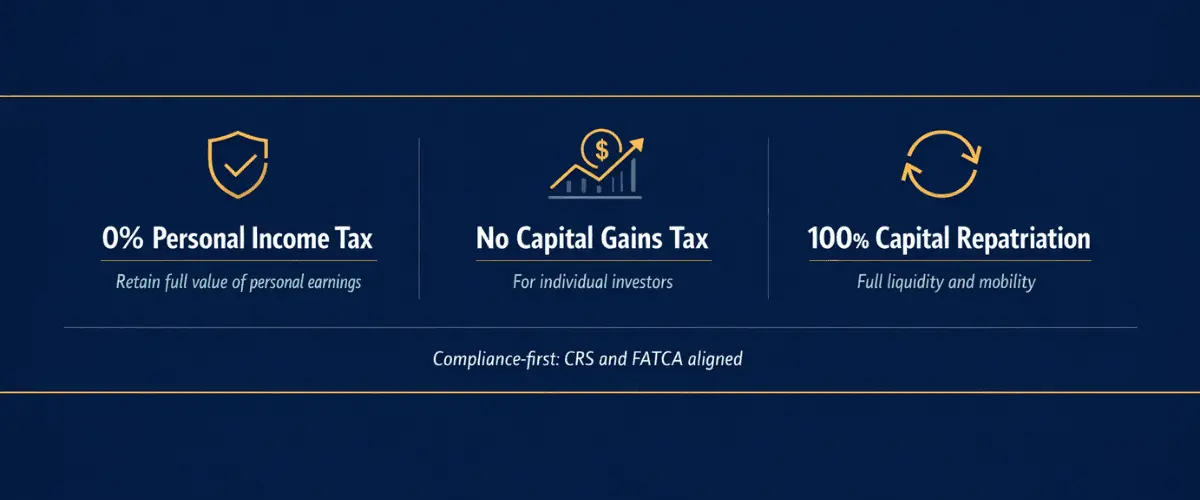
Note: Tax efficiency should not be confused with tax avoidance. Dubai operates within international transparency standards, including CRS and FATCA compliance.
Efficiency should never be confused with evasion. As global tax transparency standards such as CRS and FATCA continue to tighten, Dubai has positioned itself as a fully compliant yet highly competitive tax-efficient jurisdiction for international capital.
Strategy CheckTax efficiency is a structural advantage, but outcomes dependon strategy. Prioritize compliant structuring, clear ownership logic, and an exit plan aligned with a 7–10 year horizon.
The introduction of Corporate Tax marked Dubai’s transition into the league of mature fiscal economies. However, rather than diminishing its appeal, this evolution clarified the framework, separating business taxation from private capital investment. For long-term private investors, the environment remains one of the most attractive globally:
- Personal Income These points refer to UAE-side taxation; investors should confirm how residency, citizenship, and source-of-income rules may affect obligations in their home jurisdiction.
- Capital Gains No capital gains tax on real estate or equity appreciation for individuals, enabling long-term value creation without exit friction.
- Repatriation 100% repatriation of capital and profits, ensuring investors remain fully liquid and geographically mobile.
This structure supports true compounding. Without the drag of recurring income or capital gains taxation, asset bases held in Dubai can grow meaningfully faster than comparable investments in high-tax jurisdictions over a 7–10 year horizon.
Important:The benefits of Dubai’s tax framework materialize over time. Short holding periods rarely capture the full advantage of compounding and frictionless exits.
Dubai’s tax framework is therefore not designed to obscure capital, but to retain it efficiently, within a transparent and internationally aligned system.
Strategic Geography: Connecting Europe, Asia, and the Middle East
In 2026, the strategic value of geography, and more specifically, time zones, is often underestimated. For globally active capital, however, it remains decisive. Dubai operates within a unique temporal window (GMT+4), overlapping with the business hours of London, Singapore, Hong Kong, and New York within a single working day.
Tip:Investors managing businesses or assets across multiple regions often underestimate time-zone efficiency. Dubai’s GMT+4 position enables same-day decision cycles across Europe, Asia, and the US.
This advantage extends far beyond physical proximity or flight connections, although approximately 2.5 billion people live within a four-hour flight radius. At its core, Dubai’s geographic positioning enables operational continuity: the ability to manage capital, teams, and decision-making cycles across continents without friction or delay.
Logistics and Financial Connectivity
Under the Dubai Economic Agenda (D33), the city has accelerated its transformation into one of the world’s fastest-growing global financial and commercial hubs. The emphasis is not on symbolic rankings, but on execution, digital infrastructure, regulatory efficiency, and seamless cross-border capital mobility. These structural elements reinforce Dubai’s function as a Dubai Global Capital Hub in 2026, capable of supporting complex, multi-jurisdictional operations.
Lifestyle and Business Integration
Dubai is one of the few global cities where senior decision-makers can simultaneously oversee Eastern manufacturing networks and Western consumer or financial markets, without compromising personal security, lifestyle quality, or operational efficiency. This convergence of business functionality and lifestyle stability explains why capital increasingly chooses to establish a base in Dubai, rather than merely transit through it.
Capital Stability vs. Speculation: What Dubai Actually Offers
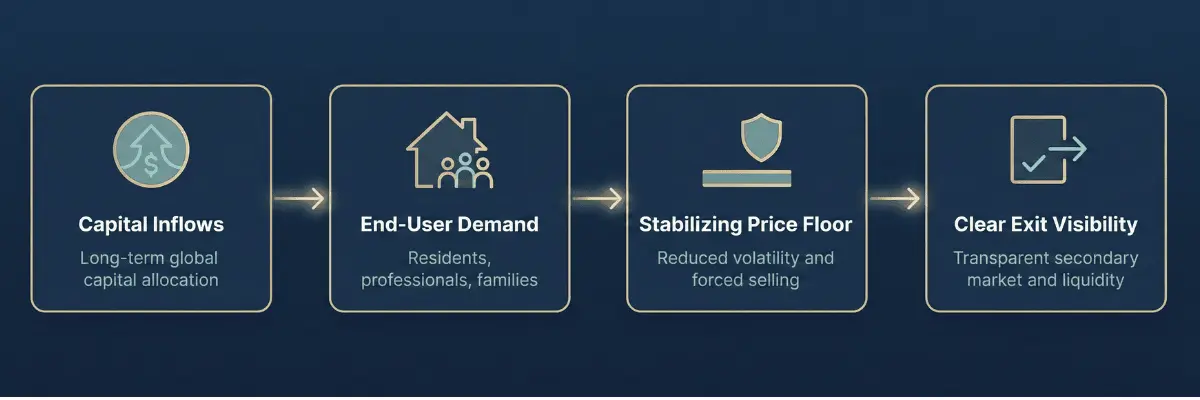
A common critique directed at Dubai is market “volatility.” While short-term price cycles exist, as they do in any open and liquid market, more sophisticated analysis shows a growing decoupling of speculative behavior from underlying fundamental value.
Warning:Treating Dubai as a purely tactical or short-term trade increases risk. Misalignment between strategy, holding period, and asset selection is the most common cause of underperformance.
The Shift Toward End Users
Unlike earlier cycles driven heavily by speculative capital, the 2026 market is supported by a sustained influx of permanent residents, skilled professionals, entrepreneurs, and families. This structural demand base has helped shift market behavior toward greater stability, reducing the market’s sensitivity to purely sentiment-driven flows in many segments.
End-user dominance alters market behavior fundamentally: owner-occupiers do not liquidate assets based on sentiment-driven headlines, creating a stabilizing floor beneath pricing across prime and mid-market segments.
Regulatory Maturity
The presence of robust oversight bodies such as the Real Estate Regulatory Agency (RERA) and the Virtual Assets Regulatory Authority (VARA) reflects a market that has moved beyond growth-at-all-costs. Regulatory enforcement, escrow requirements, and licensing frameworks significantly reduce risks related to fraud, non-completion, and counterparty uncertainty.
For long-term capital allocators, regulatory predictability, not rapid appreciation, is the cornerstone of capital stability.
Liquidity and Exit Visibility
Dubai now benefits from a mature and transparent secondary market. Entry may be straightforward, but more importantly, exit strategies are clear and executable, a critical distinction from developing markets where liquidity often disappears when it is most needed.
Price discovery, transaction velocity, and legal clarity around transfers allow investors to rebalance portfolios without relying on forced discounts or distressed exits.
The 2026 Infrastructure Pivot: Why Now?
To understand Dubai property market outlook 2026, investors must look beyond general sentiment and assess the unfolding infrastructure, regulatory evolution, and demographic shifts shaping long-term fundamentals. 2026 is not merely another calendar year; it marks a critical "infrastructure pivot" in Dubai’s urban evolution. Two major catalysts are reshaping the capital map this year:
- The Blue Line Effect: With the Dubai Metro Blue Line project moving into critical execution phases, connectivity is expanding into previously undervalued zones like Dubai Creek Harbour and Dubai Silicon Oasis. Historically, transit integration in mature global cities has been associated with measurable long-term value uplift, particularly where new connectivity materially reduces commute friction and expands end-user demand.
- The Southward Shift (DWC): As operations accelerate at Al Maktoum International Airport, the center of gravity for commercial and logistical capital is shifting South. Investors entering the market in 2026 are positioning themselves ahead of the mass migration of workforce and commercial hubs towards Dubai South, effectively buying into the "Dubai 2040" vision at today's valuations.
In 2026, you are not just buying a property; you are positioning into a widening infrastructure grid that has historically supported appreciation dynamics over longer holding periods, subject to entry price, asset quality, and location selection.
Who Is Dubai’s Capital Environment Best Suited For?
Dubai is not a one-size-fits-all solution. Its ecosystem is deliberately structured to serve specific capital profiles, each with distinct objectives related to growth, preservation, and operational flexibility.
By 2026, Dubai’s evolution into a Dubai Global Capital Hub has made it particularly attractive to investors who view capital allocation as a long-term strategic decision rather than a short-term trade.
The capital environment is especially well suited for the following profiles:
HNWIs and Family Offices
Dubai functions as a secure jurisdiction for long-term wealth structuring, intergenerational transfer, and asset governance. Legal frameworks such as foundations and trusts within the Dubai International Financial Centre (DIFC) provide institutional-grade clarity, asset protection, and succession planning options.
For family offices seeking jurisdictional stability without excessive regulatory fragmentation, Dubai represents a credible alternative to traditional European wealth hubs.
Global Entrepreneurs
For founders and business owners operating across borders, Dubai offers a rare combination of world-class infrastructure and minimal bureaucratic friction. The ability to establish, scale, and exit businesses efficiently within a tax-transparent and internationally connected environment positions Dubai as an operational headquarters, not merely a residential base.
This profile values speed of execution, legal predictability, and capital mobility over speculative upside.
Mobile Professionals
A growing segment of globally mobile professionals practices what is often referred to as jurisdictional arbitrage: earning in strong currencies while residing in a high-efficiency, tax-neutral environment.
For this group, a tax efficient investment strategy in Dubai is not an optimization layer added later. It is a foundational lifestyle and investment decision.
Case Study in Action: The "Hybrid" Preservation Strategy
To illustrate how these principles work effectively, let’s look at a representative strategy frequently adopted by European investors in the current market.
The Profile: Designed for a European business owner seeking to hedge against Eurozone inflation and optimize tax exposure on rental income.
The Challenge: High property taxes and stringent tenancy laws in home jurisdictions often result in real negative returns on real estate portfolios.
The Dubai Strategy: Instead of a random property purchase, a structured approach follows this framework:
- Jurisdiction: Establishing a DIFC Foundation to hold the assets, supporting succession planning and multi-generational governance subject to professional legal advice and the investor’s personal circumstances.
- Asset Selection: Acquiring a portfolio of "Prime" units (e.g., Palm Jumeirah & Downtown) totaling ~$4.5M, prioritizing finished assets with scarce supply.
- The Result: Such portfolios often target mid-single-digit net yield outcomes, depending on service charges, vacancy, management costs, financing terms, and asset selection. While yields vary by location and asset type, Dubai rental yield 2026 for mid- to prime-market residential assets commonly ranges between 4–7% gross, with net outcomes influenced by service charges, vacancy rates, and financing terms.
This is not just buying a condo; it is strategic wealth structuring.
Frequently asked:Is Dubai suitable for everyone? No. It is best suited for investors who view capital allocation as a long-term strategic decision rather than a short-term opportunity.
Frequently Asked Questions
Is Dubai suitable for short-term investors?
Dubai can work for short-term investors, but it is not where the best risk-adjusted outcomes are typically achieved. Transaction costs, market timing risk, and liquidity conditions can materially affect short holding periods. In most cases, Dubai is structurally better suited to medium to long-term strategies that combine rental yield, high-quality asset selection, and clear exit planning. Is Dubai’s tax system compliant with international standards?
Dubai operates within an internationally integrated framework and has aligned key elements of its tax and regulatory environment with global standards. However, compliance depends on your residency, citizenship, source of income, and reporting obligations in your home jurisdiction. For cross-border investors, the correct approach is to treat Dubai as a jurisdiction that supports transparent structuring, while ensuring full personal compliance through professional tax advice. Does Dubai still offer capital preservation advantages in 2026?
For many investors, Dubai can still function as a capital preservation market in 2026, particularly when the strategy prioritizes prime locations, end-user-supported demand, and assets with durable rental fundamentals. Capital preservation is not automatic, it is created through disciplined asset selection, conservative leverage, and a clear hold and exit framework.
Common Misconceptions About Dubai as a Capital Hub
Myth vs reality:Dubai is often labeled as a short-term speculative market. In reality, the strongest risk-adjusted outcomes have historically come from long-term positioning, supported by demographic growth, rental yield compounding, and phased urban development.
Sound capital decisions require separating structural reality from market noise. Despite Dubai’s maturation into a globally integrated financial jurisdiction, several persistent misconceptions continue to distort how investors evaluate its role in capital allocation.
Clarifying these myths is essential, not to promote the market, but to assess it accurately.
Myth Dubai is only for short-term speculation.
Reality While speculative cycles existed in earlier phases of the market, the strongest risk-adjusted returns in Dubai have historically been achieved through 7-10 year holding periods. These returns are driven by rental yield compounding, sustained population growth, and long-term urban development cycles rather than short-term price spikes.
Myth Tax-free means high risk.
Reality Tax efficiency does not imply regulatory weakness. Dubai’s legal infrastructure, particularly within common-law jurisdictions such as the DIFC, offers contract enforcement, dispute resolution, and legal predictability that often exceeds that of fragmented European regulatory environments. For many investors, this combination of clarity and efficiency reduces risk rather than amplifying it.
Myth It’s too late to enter.
Reality With the Dubai 2040 Urban Master Plan still in relatively early execution phases, asset valuations in several districts remain below replacement cost when benchmarked against mature global cities such as London or Singapore. From a capital positioning perspective, this suggests structural continuation rather than late-cycle saturation.
Conclusion: The Next Step
Dubai is not simply a destination. It is a global capital positioning decision within an increasingly fragmented financial order.
Understanding macroeconomic forces and jurisdictional advantages is only the first step. The more critical task is aligning those forces with your personal wealth roadmap, risk tolerance, and time horizon.
We help investors define a capital thesis, one that integrates capital preservation in Dubai, tax efficiency, liquidity planning, and long-term optionality within a coherent global strategy.
Define Your Dubai Capital Strategy This is not a property pitch. We help investors think through jurisdiction, capital preservation, tax efficiency, and long-term optionality, before any asset discussion.
I agree to the Privacy PolicyStart a WhatsApp Conversation
*Disclaimer:This content is for informational purposes only and does not constitute legal, tax, or investment advice.
You may also like